This guide is built specifically for non-technical founders who know exactly what they want from a software development team but are not sure how to find and evaluate the best fits. Most of them stumble through the same painful pattern: Post a job, get flooded with resumes, sit through interviews where you’re nodding along without fully understanding the answers, make a hire that feels right, and find out that it wasn’t six months later.
The problem is not effort. It lies in how you strategize your recruitment process. This guide cuts through the generic advice and walks you through exactly how to hire software developers the right way, step by step. And it shows you useful tips to not only attract qualified candidates but also filter suitable ones. Also, it tells you when to outsource software development or contract out a dedicated team.
Key Takeaways:
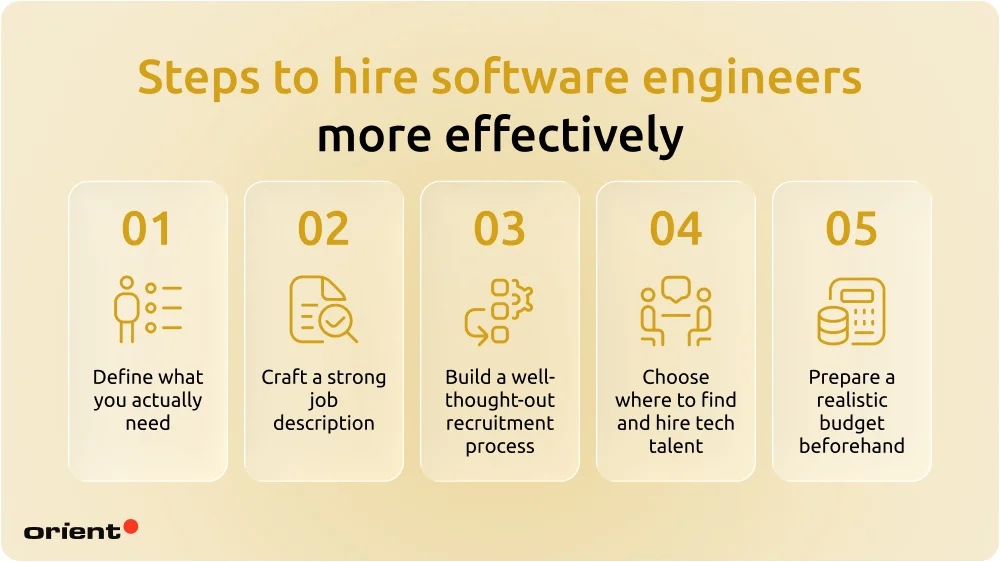
Steps for non-technical founders to hire software developers with ease:
- Diagnose your real tech needs before posting a role. Define the business problem, the right developer type, and the appropriate seniority level before writing a single line of a job description.
- Write a strong job description. Be specific about the tech stack, honest about your current situation, and transparent about compensation and work arrangement.
- Design a 3-stage interview process that evaluates communication, technical capability, and cultural alignment, not just technical knowledge.
- Decide where to source candidates based on your hiring model: Freelancers for short-term tasks, full-time hires for long-term ownership, and dedicated agencies for scalable team building.
- Set a realistic budget before you start hiring.
“Baby steps” to not just recruit the right software developer, but do it smartly
Hiring developers does not sound straightforward until you are actually doing it. The hiring process is made up of a series of small decisions. If one of them goes wrong, it may ruin the entire endeavor. That’s why you need a well-defined strategy and good preparation. Take each of the following steps carefully:
Step 1: Diagnose your real tech need, not just the job title
In reality, the most costly hiring mistake non-technical founders make often happens before a single resume is reviewed. It’s the moment when they lead with a job title instead of a business problem. They simply decide that they need software developers without clearly understanding what kind, what level, or what for.
In most cases, a project manager or leader chooses to hire “full-stack developers” or “senior engineers,” while what’s needed is someone to work on software architecture. In others, founders insist on onboarding experienced developers when mid-level professionals with good tooling would be enough.
A misstep like this can shape every decision that follows, such as who you attract, what you pay for, or whether the person you hire can deliver what the project or business needs or integrate with the existing team.

It is advised that business owners, especially non-tech ones, should define their problems first and start there rather than focusing on the role. Ask questions:
- What specific product, feature, or system needs to exist in the next 6 - 12 months?
- Are you building something new from scratch, or improving something that already exists?
- Does this role require someone to make technical decisions independently, or execute ones that are already defined?
The answers will point the way toward a clearer portrait of the candidate you need far more accurately than any job title. For example, if you need someone to build a web product from the ground up, you likely need a full-stack developer or even a small software development team, including frontend and backend, not just one single specialist.

Next, you should get to the seniority level - this is where most budgets are wasted due to wrong decisions. You need to decide how much experience the role demands in practice. Seniority is not only a matter of years but also reflects the degree of ownership, independence, and technical complexity that a role can handle. If misread, this will lead to overpaying for the experience you do not need or underpaying and getting sub-par results.
Make sure you balance your expectations for the role and what the level of seniority can match, including necessary technical skills (E.g., relevant programming languages), communication skills, and soft skills (E.g., problem-solving abilities):
- Entry/junior level: Still building foundational skills. Junior developers need mentorship, clear direction, and well-defined tasks. A poor fit for roles that require independent decision-making or technical leadership.
- Mid-level: Works independently, exercises sound technical judgment day-to-day, and executes without hand-holding. The most cost-efficient hire for the majority of early to mid-stage product work.
- Senior level: Senior developers can add genuine value when you need architectural decisions, complex system design, or someone navigating high-stakes coding challenges.
The match between seniority and project scope is one of the most overlooked levers in developer hiring. Getting it precisely from the beginning can save you both time and money.
Once well defined, document everything before you proceed to the second step.
Step 2: Write a strong job description that speaks to developers
What is documented in step 1 will become the source of truth for all involved in the recruitment process, from whoever plans the JD to whoever conducts the final interview. In this step, you translate what’s already defined into a compelling job description that accurately portrays the role you are going to hire and communicate what qualities you demand from potential candidates.
Experienced developers can read job postings with a critical eye. And they can immediately tell when a JD is written by someone who does not understand the role, copied from a template, or generated by AI.

If you do not want to repel the right candidates with your job postings, there are a few principles you should follow:
- Always write for the candidates reading it, not for the HR checklist: A JD that works is clear, specific, and honest, giving the direct answers to the questions a strong candidate actually asks before applying. For example, what will I be building, and why does it matter? What does the technical environment look like? What level of ownership and autonomy will I have? Is the company realistic about what they need, or is this a wish list dressed up as a job post?
- Always be specific and honest about the tech stack: Instead of being vague about technology requirements, you should list the actual stack you seek: The coding languages, development frameworks, databases, and infrastructure your in-house team uses day to day. Also, be honest about your current state of tech stack. For example, your codebase is messy, legacy, or in need of refactoring. A polished job description can never hide the reality. It is important to remember that this is not only about hiring top-tier developers but also retaining them in the long run. Only transparency can build trust and filter for candidates who are genuinely comfortable with your situation.
- Always separate must-haves from nice-to-haves: Don’t mistake that all requirements are equally important. You are creating an exhaustive requirement list that scares the potential candidates away. Instead, split your requirements into two categories: The must-have skills or experience the role cannot do the job without, and the skills that will be a plus but will not disqualify a candidate. A practical test to verify your list: If a candidate were outstanding in every other area but lacked this specific skill, would you still walk away? If not, it is nice to have.
- Always be transparent about compensation and work arrangement: Salary range, remote or on-site expectations, and working hours are among the first things developers look for. Hiding this information creates friction that causes strong candidates to disengage before they even apply. Companies that are upfront about compensation consistently attract more and better applicants than those that aren’t.
Step 3: Design a 3-stage interview process that filters qualified candidates from good talkers
Next, prepare the core of your hiring strategy - a structured interview process that can evaluate developers even when you are not technical. Lots of founders make the mistake that this process is only about technical assessments. In reality, an effective evaluation should cover three different dimensions: Communication, technical capability, and cultural alignment.
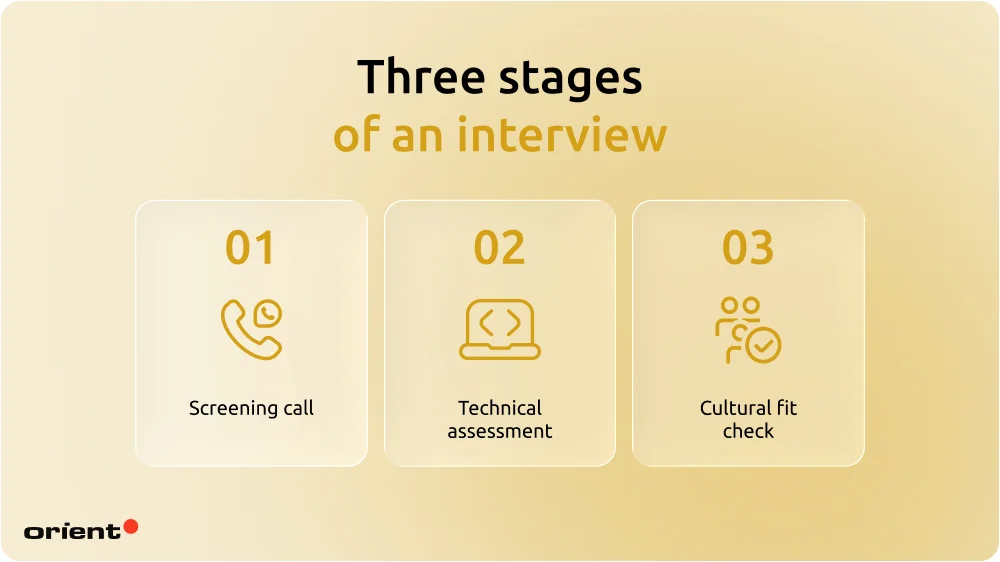
Three stages of an interview
- Screening call
- Technical assessment
- Cultural fit check
Stage 1: Screening call to filter for communication and clarity
Before you conduct technical interviews, it is necessary to test candidates with two-way conversations via short calls. The purpose is to determine if an applicant is worth going further.

Three criteria to assess at this stage:
- Clarity of communication: Can they explain what they have built and what they want next in plain, structured language? Developers who struggle to communicate at this stage rarely improve once they are writing code under deadline pressure.
- Genuine motivation: Are they interested in your problem? Strong candidates ask specific questions about your product, your tech challenges, and your team, not just salary and benefits.
- Basic alignment: Is there an immediate mismatch on compensation expectations, working arrangement, timeline, or availability? Surface these early rather than discovering them after three rounds of interviews.
Stage 2: Technical interview to filter for real skills over knowledge on paper
This is the step nobody tells non-technical founders or hiring managers about how to handle, and it’s the one that causes the most damage when done poorly.
Most either rely on abstract algorithm puzzles or coding tests that have little to do with the actual work of the in-house developers. However, either way only reveals one thing: Whether a candidate can solve a predefined problem under artificial conditions. It tells you nothing about how they communicate, how they approach ambiguity, whether they write maintainable code, or how they perform when working within a real team on a real software product.

The good news is that you don’t need to know how to code to evaluate a developer’s capabilities. What you need is a structured approach and the right questions to ask.
- Review portfolios and GitHub before the interview: Check the candidate’s portfolio and GitHub profile, but remember to look beyond the surface. What you should look for is meaningful project history, and use the findings to ask specific, relevant questions when you interview the candidate.
- Bring in a technical advisor: If your in-house team does not have a tech leader, involve someone with technical expertise and experience in the interview. For example, a fractional CTO (chief technology officer - part-time technology executive who provides strategic leadership, architectural oversight, and technical guidance on an as-needed basis) or senior tech consultant.
- Include technical tests in the hiring process as a crucial part, but not a shortcut: A well-designed technical test is short, designed around the actual work the developers will be doing if they get hired. It is advised to position the test after the conversational interview, not before. By doing it, you have a meaningful context to fully assess a candidate in terms of both what they can build and how they think when faced with a real problem in the development process.
Stage 3: Cultural alignment interview to filter for how a candidate fits into a team
Company culture comes first for a reason. A developer who passes through every technical gate can still be a wrong hire if he or she cannot collaborate effectively within your current team.

At this stage, we no longer ask questions about technical knowledge. You need to check the working style, values around code quality, and communication habits under pressure, and how they handle the inevitable friction that comes with building software in a team. Structure this stage around four areas:
- Feedback and code reviews: How do they give and receive feedback on their code? Developers who are defensive about their work or dismissive of others’ contributions create friction that slows entire teams down. What you are looking for is someone who treats code review as a collaborative tool, not a personal judgment.
- Attitude toward technical debt: How do they handle situations where they are asked to ship fast at the expense of code quality? There is no universally correct answer, but their response needs to align with how your team actually operates. Someone who never compromises will struggle in a fast-moving environment. Someone who always cuts corners will leave a codebase that the next developer spends months untangling.
- Communication and transparency under pressure: How do they handle being blocked, behind schedule, or facing an unsolved problem? Developers who go quiet under pressure are significantly harder to manage than those who surface problems early, even when the news is bad.
- Autonomy versus collaboration: Do they prefer to be handed a problem and solve it independently, or do they work better with frequent check-ins and shared decision-making? Neither preference is wrong, but the answer must match the reality of your working environment.
Step 4: Decide where to source potential candidates
Once you know who to hire and how to assess a capable developer, the next important decision is to choose where you source candidates. It is not simply about which platform to post on, but more. You need to understand different hiring models and various talent markets before making a move.
There are three common models non-technical founders and managers can consider, each with its own geography, cost-structure, advantages, and trade-offs.
- Freelance software developers
- Full-time hires
- Dedicated teams/agencies
Where you scout for potential candidates depends entirely on which model fits your current stage and project requirements.
For freelancers
Freelance or temporary developers are best suited for short-term, well-defined tasks that need to be done quickly without requiring long-term commitment. For example, a specific feature for a mobile app. These are the easiest and fastest to hire. You can find them on popular platforms like Toptal, Upwork, Contra, Freelancer, etc.

If you decide to fill the gap on a temporary basis with non-staff developers, geography is largely irrelevant. Freelance platforms already handle the vetting, payment infrastructure, and communication tools. So, you work with developers across the globe as easily as the ones in your own city. What matters here is the quality of their profiles, the strength of their portfolio, and the reviews from previous clients, not where they are located.
Full-time developers
Hiring full-timers makes sense when you demand consistent ownership over the work, long-term team integration, and someone who not only joins your team for temporary tasks but also grows with your company. For example, a PHP developer, a data scientist for data engineering, or a designer for building user interfaces.

This is considered a traditional model that requires the most effort and the longest hiring timeline (it can take up to a few weeks or more). However, it pays off significantly when the role demands ongoing technical ownership and deep familiarity with your codebase. When sourcing full-time developers, you can draw from three distinct talent markets.
- Established tech markets (the U.S., the U.K, Germany, Canada, etc.): They offer the deepest pools of senior talent, strong engineering cultures, and developers with extensive experience working in product-driven environments. But the trade-off is high cost and competition.
- Emerging tech hubs (Vietnam, Poland, Romania, Colombia, etc.): These combine sizable talent pools with solid technical quality and reasonable cost efficiency. Developer communities in these countries have matured significantly over the past decade, producing engineers with strong fundamentals, international project experience, and increasingly competitive English proficiency.
- Specialist or boutique destinations (Countries or regions known for specific technical strengths or advanced technology, such as Israel for cybersecurity, Estonia for fintech, or Ukraine for engineering depth).
Dedicated developers or offshore teams through agencies
Outsourcing to a third-party company for augmented staff and dedicated teams is the most practical path for non-technical founders and hiring managers. Through a reliable partner, you can access global talent and move faster without worrying about lengthy hiring processes. The best thing is that business owners can avoid the overhead of direct employment.
In this hiring model, geographical locations are more important. Where your outsourcing partner is based directly determines the cost, collaboration style, and talent quality you can expect.

- Onshore agencies: Partners operating within the same country as your business. They are the most straightforward to work with since there are no time zone gaps, no language friction, and no legal complexity to navigate. What you pay for is that convenience, as onshore partners carry the highest rates. This model works best when your project involves sensitive data, strict compliance requirements, or a level of daily coordination that does not survive a time zone gap.
- Nearshore agencies: Partners in neighboring or nearby regions with overlapping or compatible time zones. It is no surprise that nearshore outsourcing is the fastest-growing model among startups and growth-stage companies today. Time zones overlap enough for real-time collaboration; cultural alignment is generally strong, and the cost advantage over onshore partners is significant.
- Offshore agencies: These partners offer the most competitive rates and the broadest access to global tech talent. That’s why this is known as the most budget-efficient option; however, with a trade-off. The significant time zone differences require stronger project management, documentation, communication protocols, and more structured delivery processes. Not all offshore markets are equal. Each country offers cost advantages, but the extent varies significantly alongside differences in talent depth, English proficiency, time zone compatibility, and agency maturity.
So, you have to weigh the pros and cons of each option to consider hiring remote developers or on-site ones.
Step 5: Set realistic budgets before you start hiring
Most non-technical founders budget for the salary and forget everything surrounding it. The true cost of hiring a software developer extends well beyond compensation. It includes recruitment fees, onboarding time, employment overhead, tooling, and most critically, the cost of a bad hire. These are estimated by research to be three or five times a developer’s annual salary when rework, lost productivity, and restart costs are factored in. Before committing to a hiring model or a talent market, get clear on what the business can realistically sustain because the right hire at the wrong budget is just a slower version of the wrong hire.
Not any tips, but practical ones to recruit the qualified candidates
If you can follow a structured hiring process, you have gotten most of the way there. What follows will help you close the gaps and sharpen the execution.

#1 Never rush to make hiring decisions
Hiring pressure can lead to bad decisions and wrong hires. Especially when a role stays vacant too long, the internal push to fill the gap gets louder. Under that urgency, even the wrong hires may look right.
What you can do is to set a minimum timeline for your hiring goal and commit to it regardless of internal pressure. A practical benchmark is two to three weeks between first contact and final decision for most developer roles. Use that time to run all three stages properly, compare candidates against the same criteria, and let the process do what it was designed to do. If a candidate has not cleared every stage of your process, the role is not ready to be filled. Note that the vacancy is always cheaper than a mis-hire. The longer it takes to fill a vacancy, the more careful you must be to pick and choose the right fit.
#2 Offer freshers and junior developers opportunities to grow
Not every role requires a senior level, and defaulting to experience for every hire is the most expensive habit a non-technical founder can take.
In fact, the best software developers are not always the most experienced ones. Freshers and junior developers hired with intention and supported properly can become the most loyal and deeply embedded members of a technical team. They grow inside your codebase, absorb your product thinking early, and develop their standards within the culture you have built. This is the kind of alignment that seniority hired off the market rarely brings, not to mention that even a senior software engineer still needs time to adapt to new environments and projects.
Therefore, when scoping a role, ask honestly whether it requires seniority or just capability. If the work is well-defined and the team has the capacity to support a less experienced hire, bring in an entry-level developer or fresher with strong fundamentals and genuine drive. Pair them with a more experienced developer, give them real ownership from day one, and set clear growth milestones. The return on that investment compounds over time.

#3 Move fast once you decide because top candidates do not wait
We’ve advised you not to rush. Still, it does not necessarily mean you can relax, especially in today’s competitive market for top-tier talent. Before your final interview, make sure the offer is ready internally, including compensation, terms, and any required approvals.
Once you have made your decision, speed is everything. Send the offer the same day if possible. Strong developers are evaluating multiple opportunities simultaneously, and the speed of your response communicates as much about your company as anything said during the interview. If you do not want to lose the best candidates to other competitors, preparation in advance is the key.

#4 Do not compete on salary alone. Compete on vision
Trying to win a developer purely on salary is a losing strategy. Established companies and well-funded competitors will almost always outbid a startup or growing business on compensation. What they cannot offer is ownership, early-stage impact, and the chance to build something from the ground up. Lead with that.
Not all candidates worth hiring are chasing the highest number. Many of them are after an opportunity to build something meaningful, a problem worth solving, or a founder who actually knows where they are going. You can attract developers who are motivated by real ownership over technical decisions.
However, it does not necessarily mean ignoring compensation entirely. Pay fairly within your range and be transparent about it. But do not apologize for what you cannot match. Instead, make the clearest possible case for what you can offer that no established company can: Meaningful work, real ownership, and a seat at the table while the product is still being shaped.
Outsourcing tips: When to stop DIY hiring & let experts handle the recruitment process
Do-it-yourself (DIY) recruitment works until it does not. At some stages, the smarter hiring decision is knowing when to stop handling it yourself and ask for external support.

- You’ve reopened the same role more than once: If the same position has been filled and vacated within a short period, or has been sitting open through multiple hiring attempts, it’s time to consider outsourcing.
- You’re spending more time on your recruitment process: Sourcing, screening, interviewing, and following up with candidates is a full-time responsibility when done properly. For a non-technical founder already managing product, operations, and growth, absorbing that load on top of everything else is not sustainable. When hiring starts pulling you away from the work that actually moves the business forward, it is no longer a process you should be running alone.
- You’re not confident evaluating candidates technically: This is the most honest signal of all. If you are making final hiring decisions based primarily on how candidates present themselves rather than what they can actually deliver, you are operating on impression rather than evidence. A professional recruiter or outsourcing partner with technical hiring expertise brings the evaluation capability that fills exactly that gap.
- Your timeline is too short for a full hiring cycle: The average time to hire a developer through a DIY process runs between 45 and 60 days from first posting to signed offer. If your project cannot absorb that timeline, or if you need a capable developer integrated and contributing within weeks rather than months, a specialist partner with an existing vetted talent pool will always move faster than a process built from scratch.
- You need a full team, not just a single developer: This is often when the scope has outgrown what DIY hiring can handle. A specialist partner can help you assemble a full-fledged team with the right composition, seniority balance, and complementary skill sets. At this point, outsourcing stops being a convenience but becomes a strategic necessity.
Last notes

In a nutshell, the founders who can hire qualified developers and build strong teams are not necessarily the most technical or the most experienced at recruitment. They are the ones who can clarify what they actually need and structure a process designed for candidate selection and evaluation. Clarity is the ultimate key to how to hire a software developer the right way.
It starts with understanding the role and its requirements, continues through a structured hiring cycle that does not rely on gut feeling or bias, and ends with honest assessment and transparent negotiation. Take what this guide has given you, apply it deliberately, and the right developer is closer than you think.