

Common Software Security Issues & Strategies to Prevent Their Impact

Content Map
More chaptersAre you concerned about the security of your business’s software? In today’s latest software development technologies, software security is a top priority for businesses of all sizes. With the growing number of security vulnerabilities and the increasing reliance on technology, it is crucial to take proactive measures to secure software systems and data.
As a business owner, you cannot afford to overlook the importance of software security. A single security breach can have devastating consequences, including financial loss, reputational damage, and legal consequences. In this article, we will provide an overview of the top software security issues that you need to know to keep your business secure.
We will cover the most common types of software security vulnerabilities, how they can impact your business, and provide actionable tips on how to prevent and fix security vulnerabilities. With the insights from this article, you can be confident that you are improving software security and taking the necessary steps to keep your business secure in today’s digital landscape.
Why Software Security Issues Happen
Software security vulnerabilities don’t appear randomly. They occur for many different reasons. What are they?
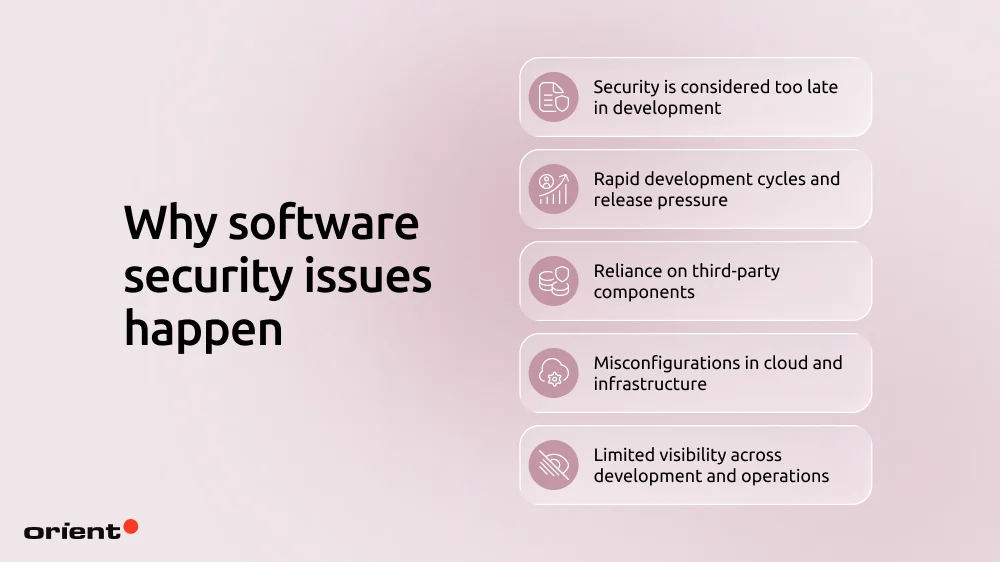
Security Is Considered Too Late in Development
For many software projects, security is treated as a final checkpoint rather than a continuous practice. Instead of integrating it at every step throughout the development lifecycle, teams view security testing as a separate activity performed during testing or auditing, focusing primarily on functionality and performance in the early and middle stages of the project. In practice, this means developers write code without running static application security testing (SAST) or secure dependency scans during development.
This approach doesn’t present tangible risks during development, but it gradually exposes weaknesses and vulnerabilities in the security system after your product is launched.
When large portions of the system are already complete, fixing a vulnerability may require redesigning authentication flows, rewriting database queries, or modifying API contracts. Whether you like it or not, such changes will inevitably disrupt your schedules to some extent. Applying short-term fixes instead of addressing the root cause, while a good solution at a given time, creates a backlog of unresolved security risks over time.
Rapid Development Cycles and Release Pressure
Modern development emphasizes short development cycles and continuous delivery practices. Instead of traditional methods, today’s teams prioritize the application of Agile workflows, continuous integration, and continuous delivery to respond quickly to market demands. However, these modern methods can introduce new security challenges if security practices don’t evolve with them.
No more weeks or months available to audit the system before deployment, the latest approaches require teams to release new versions multiple times per week or even per day. When development accelerates, but security processes remain slow or manual, vulnerabilities are more likely to slip into production.
Under time pressure, development teams often tend to prioritize delivering new features or fixing urgent bugs, leading to security-related improvements like refactoring authentication logic being postponed to avoid delaying a release. It is these postponed issues that increase the system’s overall risk over time.
Reliance on Third-Party Components
Open-source frameworks, libraries, and external packages offer users countless benefits in terms of convenience and flexibility. This is why they are widely used in software projects. However, heavy reliance on third-party components to accelerate development and avoid reinventing common functionality also introduces security risks.
A typical enterprise application may include dozens or even hundreds of dependencies, many of which depend on other packages. If a vulnerability is discovered in one of these libraries, any application using that component may also become vulnerable. Because developers do not have full control over the underlying code, they are almost powerless when attackers penetrate the system. Cybercriminals often exploit this security vulnerability to scan the internet for systems running outdated versions of widely used frameworks or libraries, leading to the collapse of the security network.
Misconfigurations in Cloud and Infrastructure
Not all security issues originate from application code. Many vulnerabilities arise from misconfigured infrastructure or cloud services.
Many cloud security issues stem from misunderstandings of the Shared Responsibility Model, where the cloud provider secures the underlying infrastructure while customers remain responsible for configuring and protecting their own resources. This means that cloud security is a collaborative effort between both the cloud vendors and the users. If users improperly configure storage services, use overly permissive access policies, or publicly expose administrative interfaces, all of these unintentionally make sensitive systems accessible to attackers.
Without continuous configuration monitoring and security validation, errors can persist unnoticed until they are discovered through exploitation or external security research.
Limited Visibility Across Development and Operations
In many organizations, development, operations, and security functions still operate in separate workflows with limited shared visibility. Developers focus on building and releasing features, operations teams manage infrastructure and deployments, while security teams often review systems independently through audits or vulnerability assessments. On the surface, everything seems normal. However, in reality, this separation creates communication gaps and inconsistent security practices.
For example, developers may deploy features without fully understanding operational security policies, while security teams may only review systems after deployment. Without collaboration across these functions, vulnerabilities may go unnoticed until they are exploited.
Impact of Software Security Issues
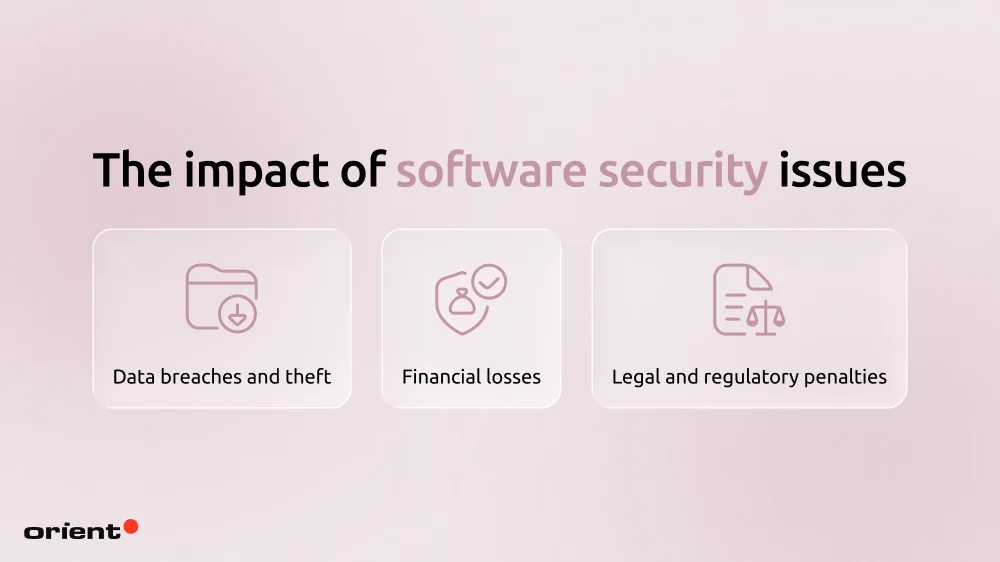
Data Breaches and Theft
Data breaches and theft are perhaps the most significant consequences of software security vulnerabilities. When a company’s software is compromised, sensitive customer data such as credit card information, personal identification numbers, and social security numbers can be stolen. Such data can be sold on the black market, leading to identity theft and financial loss for customers. Moreover, data breaches can cause significant reputational damage to a company, which can be difficult to recover from.
One example of a company that has experienced a data breach is Equifax, a consumer credit reporting agency. In 2017, Equifax suffered a massive data breach that exposed the personal information of 143 million consumers. The breach resulted in a public outcry and a $700 million settlement with the US Federal Trade Commission.
Financial Losses
Financial losses can also result from software security issues. For example, if a company’s financial software is hacked, transactions can be manipulated, leading to financial losses for the company and its customers. Additionally, companies may need to spend significant amounts of money to remediate the damage caused by a security breach, such as hiring cybersecurity experts or implementing new security measures.
A real-life example of a company that has experienced financial losses due to a software security issue is Target. Target experienced a data breach in 2013 that exposed the debit and credit card data of 40 million consumers. The hack cost the corporation $202 million in missed income and expenditures.
Legal and Regulatory Penalties
Legal and regulatory penalties are also potential consequences of software security issues. Companies may be subject to fines, legal judgments, and regulatory action if they fail to adequately protect their customers’ data. This can result in high costs for the company and damage to its reputation.
As a case study, in 2016, Uber suffered a data breach that exposed the personal information of 57 million users and drivers. The company paid a $148 million settlement with US state attorneys general and agreed to implement new security measures.
d
Common Software Security Issues
To safeguard your brand and customers, it’s crucial to focus on secure software development practices. Software developers require an understanding of the various types of security weaknesses and strategies for mitigating them. Here, we highlight the top common types of software security risks.
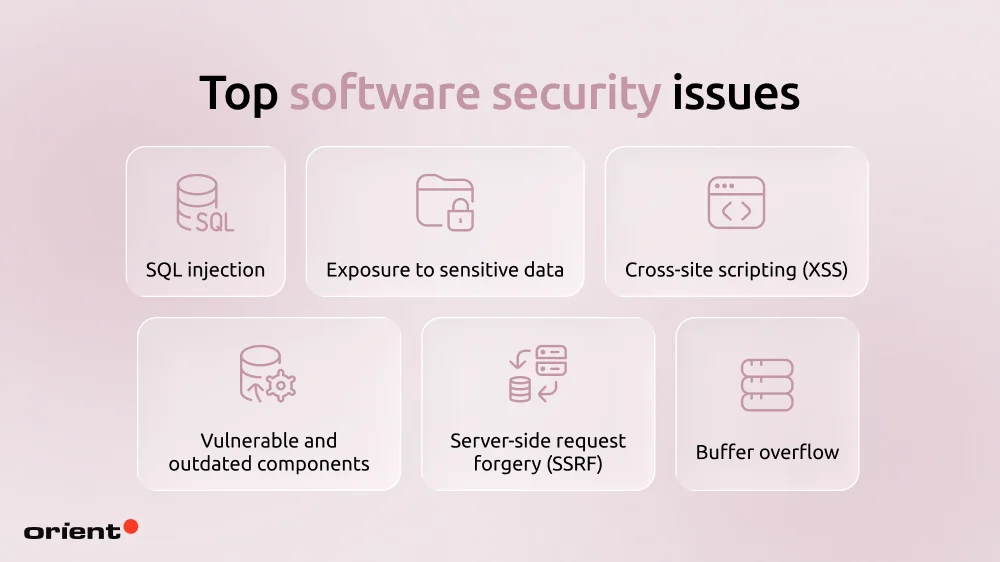
SQL Injection
SQL injection is a type of security vulnerability in which attackers exploit weaknesses in SQL queries to gain unauthorized access to a database. SQL injection attacks involve inserting malicious code into a website or application’s SQL statement, allowing attackers to access, modify, or delete critical data stored within the database.
SQL injection can have severe consequences, including the theft of sensitive data, website defacement, and even full database compromise. This type of attack is prevalent because many websites and applications use SQL databases to store user data and are vulnerable to SQL injection attacks if they do not follow secure coding practices.
SQL injection attacks can occur in the following ways:
- User input: SQL injection attacks often occur when user input is not validated or sanitized properly. Attackers can inject malicious code into user input fields, such as search bars or login forms, to execute SQL commands on the database.
- Poorly designed SQL queries: SQL injection threats are also possible if SQL queries are not designed securely. For example, if a SQL query is constructed using string concatenation instead of parameterized queries, an attacker can manipulate the input to inject malicious code into the query.
- Vulnerable software: SQL injection assaults are possible if the software is not properly secured or if there are vulnerabilities in the software that allow attackers to execute SQL commands. Attackers can exploit these vulnerabilities to execute arbitrary SQL commands on the database.
Once a SQL injection attack is successful, an attacker can gain unauthorized access to sensitive data, modify or delete data, or even gain control of the entire system.
Exposure to Sensitive Data
Exposure to sensitive data can occur when data is stored or transmitted insecurely or when unauthorized users gain access to the data. It’s a serious software security issue that can have significant consequences for businesses and individuals.
Sensitive data exposure can happen in various ways, including:
- Unprotected storage: Sensitive data can be exposed if it is stored in an unsecured location, such as a server with weak passwords or a database without proper encryption. Attackers can gain access to the data by exploiting vulnerabilities in the system or by using brute force attacks to crack weak passwords.
- Unsecured transmission: Insecure networks and unencrypted transmissions of sensitive data both increase the risk of exposure. Attackers can intercept the data by using tools such as packet sniffers or by exploiting vulnerabilities in the network.
- Insider threats: Employees or contractors with access to sensitive data can intentionally or unintentionally expose the data by sharing it with unauthorized parties or mishandling it. This can happen if an employee’s account is compromised or if an employee is not properly trained in data handling practices.
- Third-party breaches: Sensitive data can be exposed if it is stored or processed by third-party vendors or partners. If the third-party experiences a security breach, the sensitive data can be compromised.
Cross-site Scripting (XSS)
Cross-site scripting (XSS) is a security flaw that allows attackers to inject malicious code into a website, which then executes in the user’s browser. This can lead to sensitive information theft or unauthorized access to a user’s account.
XSS attacks can occur when a web application allows user input to be included in a web page without properly sanitizing or validating it. This can occur in several ways, including:
- Reflected XSS: If a search form on a website allows users to enter search terms that are then displayed on the search results page, an attacker can inject malicious code into the search terms and have it executed by other users who view the search results.
- DOM-based XSS: This occurs when user input is used to modify the Document Object Model (DOM) of a web page. This can happen when a web application uses JavaScript to dynamically update the web page content based on user input. An attacker could inject malicious JavaScript code that is then executed by other users who view the modified web page.
Vulnerable and Outdated Components
Modern applications rely heavily on external libraries, frameworks, and other software components. When these components contain known vulnerabilities or are not updated regularly, they can introduce security risks into the entire application.
Vulnerable component issues often occur due to:
- Outdated libraries: Applications may continue using frameworks with known security flaws.
- Unpatched dependencies: Security patches released by vendors may not be applied promptly.
- Hidden transitive dependencies: Developers may not realize that indirect dependencies also introduce vulnerabilities.
Because attackers often scan for systems running outdated software, applications using vulnerable components can become easy targets for exploitation. Regular dependency monitoring and timely patching are essential to reducing this risk.
Insecure Direct Object References (IDOR)
Insecure Direct Object Reference occurs when an application exposes internal object identifiers, such as database record IDs, filenames, or account numbers, without properly verifying whether the user is authorized to access the requested resource. Instead of enforcing strict access control on the server side, the application assumes that users will only request objects that belong to them.
This vulnerability is particularly common in web applications and APIs that allow users to retrieve resources by referencing identifiers in URLs or request parameters.
IDOR vulnerabilities usually arise due to several development and design issues:
- Predictable identifiers used in requests: Many systems rely on sequential or easily guessable IDs when referencing internal objects such as invoices, user accounts, or documents. Attackers can manipulate these identifiers to access resources belonging to other users.
- Authorization checks that only verify authentication: Some applications confirm that a user is logged in, but fail to verify whether the user has permission to access the specific resource being requested.
- Direct exposure of internal objects: Instead of mapping user requests to securely controlled resources, the application exposes raw database identifiers or file paths that users can modify.
If exploited successfully, IDOR vulnerabilities can allow attackers to view, modify, or delete resources that belong to other users, potentially exposing confidential information or compromising the integrity of application data.
Server-Side Request Forgery (SSRF)
Server-Side Request Forgery occurs when an attacker manipulates an application into sending unauthorized requests to internal or external systems. Instead of accessing those systems directly, the attacker exploits the application server as an intermediary to perform the request.
SSRF vulnerabilities can occur in several common scenarios:
- Applications that retrieve resources from user-provided URLs: Features that allow users to fetch images, documents, or web content from external sources may enable attackers to supply malicious URLs that redirect the server to internal systems.
- Servers that have access to internal services: Because application servers often communicate with internal APIs, databases, or cloud services, attackers may exploit SSRF vulnerabilities to interact with systems that are not publicly accessible.
- Insufficient restrictions on outbound network requests: If the application does not enforce strict rules on which addresses the server can contact, attackers may use it to scan internal networks or access protected endpoints.
Through SSRF, attackers may access internal systems that are not publicly exposed, retrieve sensitive information, or interact with backend services that were intended to be private.
Buffer Overflow
Buffer overflow is a vulnerability that occurs when a program writes more data into a memory buffer than it was designed to hold. Because buffers have fixed sizes, any excess data may overflow into adjacent memory areas and overwrite important program data.
This issue commonly arises in applications written in low-level programming languages that allow direct memory management. When input size is not properly validated, attackers may provide specially crafted data that exceeds the buffer’s allocated size. The overflow can corrupt memory structures, modify program variables, or overwrite control data used to manage program execution.
Buffer overflow vulnerabilities may occur under several conditions:
- Input data that exceeds allocated buffer size: When programs accept input from users, files, or network requests without validating the length of the data, the input may exceed the memory space allocated for it.
- Unsafe memory handling functions: Certain programming functions copy or concatenate data without automatically enforcing boundary checks, which can allow excess data to overwrite nearby memory locations.
- Programs that directly manage memory without safeguards: Applications that rely on manual memory allocation may fail to enforce proper limits, increasing the risk of memory corruption.
Strategies for Preventing Software Security Issues
There are several strategies that can help prevent software security risks from occurring in the first place. Here are some best practices for preventing software vulnerabilities:
Keeping Software Up-to-date
Keeping your software development life cycle up-to-date is critical. Software vendors regularly release updates that address security vulnerabilities, so it’s important to install these updates as soon as they become available. These updates may include bug fixes, security patches, and other improvements that can help keep your software security tools safeguarded.
Failing to update the software can leave your systems vulnerable to attacks that exploit known vulnerabilities. Attackers are well aware of the vulnerabilities in popular software programs, and they often target systems that haven’t been updated with the latest security patches. In fact, many high-profile data breaches have been caused by attackers exploiting known vulnerabilities in unpatched software.
To ensure that your software development lifecycle is always up-to-date, you can enable automatic updates for your operating system and other software programs. You should also regularly check for updates manually and install them as soon as they become available.
Conducting Regular Security Audits and Vulnerability Assessments
Regular security audits and vulnerability assessments can help identify potential security risks before they are exploited. These assessments can help you identify vulnerabilities in your software, network, and systems, allowing you to take steps to address them before they can be exploited by attackers.
Security audits typically involve a comprehensive review of your systems and software development processes to identify potential security issues. This may include reviewing access controls, identifying vulnerabilities in software and hardware security, and assessing the effectiveness of your security policies and procedures.
Vulnerability assessments are typically more focused and involve identifying specific vulnerabilities in your systems and software. This may involve running vulnerability scans on your network, testing your web applications for security holes, and reviewing your systems for known vulnerabilities.
Providing Security Awareness Training Programs
Finally, providing employee training and awareness programs can help prevent software security issues by educating not only cybersecurity teams but also any employees about the risks and best practices for avoiding them. Training programs help employees learn how to access secure data, recognize phishing scams, avoid downloading malware, and follow best practices for password security, among other things.
Employees may inadvertently download malware, fall for phishing scams, or use weak passwords that can be easily guessed or cracked. By providing training and awareness programs, you can help employees understand the risks and best practices for avoiding them.
Training programs may include online courses, secure code training, or simulations that help employees learn how to recognize and avoid common cybersecurity threats. You may also provide regular reminders and updates to employees to keep them informed about new security threats and best practices.
Conclusion

It’s clear that software security is an ongoing concern that requires constant attention and effort. With the right approach, however, you can significantly reduce the risk of software security issues and protect your systems and data from harm.
At Orient Software, we understand the importance of software security and offer a range of services to help businesses protect themselves against these threats. We’re committed to working closely with our clients to ensure that their security needs are met.
If you’re concerned about software security issues and want to take proactive measures to protect yourself, we encourage you to consider outsourcing your security system to Orient Software. Our expert team can help you implement the best practices and strategies for preventing software development security issues, so you can concentrate on operating your business with peace of mind.